Blog: 2024 Japan Training Trip
A group of Dayton Bujinkan Dojo students and instructors were in Japan from September 26 to October 6, 2024 for training. Training sessions emphasized kyojitsu (misdirection) and drilling fundamentals to internalize movement. Many of the Daishihan stressed taking balance before executing techniques and maintaining strict focus during practice. A key lesson involved studying the ryu-ha kata to find its core lesson before exploring variations to adapt to different attacks.
More photos from the trip are available at https://www.daytonbujinkan.com/photo-gallery-ii/2024-japantrip.


(The following post is a condensed version of Jeff’s full, detailed trip journal.)
Class sizes swelled to 50+ participants, rare in recent times. We met and trained with other practitioners from Lithuania, Austria, Germany, United Kingdom, France, Canada, Italy, and Spain.
We visited Asakusa Senso-ji temple, Shibuya, Omote Sando, Harajuku, and Akihabara Electric Town. We also visited Fender Flagship of Tokyo, a recently opened three story, one-of-a-kind museum/guitar store where Mike Ockerman gave us a master class and tour in Fender guitars.
Classes were held by Nagato Sensei, Noguchi Sensei, Someya Sensei, and Paul Masse.
Paul Masse focused on kyojitsu (truth and false), exploring ways to express this principle in both unarmed and armed training scenarios. A common theme was to hide the true intent of one’s movement through misdirection and change inputs to cause chaos/confusion, so that the opponent isn’t able to determine what’s going on. Paul emphasized the importance of not being predictable and reducing any chance of repeating a pattern which your opponent might identify and use against you.
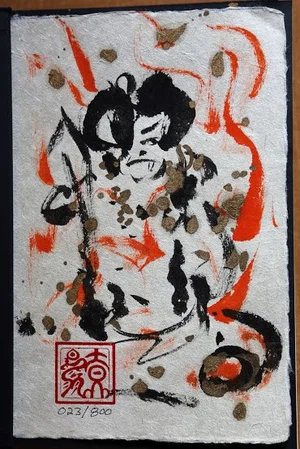
During tea break midway through class, Paul created artwork and calligraphy for students. Mike received a four-character yojijukugo (四字熟語) calligraphy to study. Charles received a perfectly drawn rose.
Someya Sensei’s classes focused on reviewing kata and waza from the Ten Chi Jin Ryaku no Maki and kata from the Takagi Yoshin Ryu. Sensei stressed the need to let the opponent throw the tori a few times to understand the timing, rhythm, and flow of a swift attack. Sensei reminded us that the basic way to train is to “move, take balance, and then perform the waza”.
Someya Sensei shared that many practitioners in the Bujinkan only train softly, confusing their misguided successful results from the kata in the name of safety. Although it is important to train safe, hard training at certain times shows what’s needed to execute a technique with the correct flow. It is part of Shu Ha Ri.
Someya Sensei stressed that training slows as we age, but in the life span of a budo practitioner we should have hard training when our bodies and taijutsu can support it in a safe manner. If we do not train hard at some point in our own musha shugyo, we will be surprised when techniques and kata do not work, or the opponent’s balance isn’t so easily manipulated. Sensei’s critical eye reminded us to train smart.
Noguchi Sensei’s classes were fast paced and full of energy. At 81, Sensei focused on exploring Koto Ryu kata and Takagi Yoshin Ryu kata. Sensei introduces the basic form and then quickly pivots to variations and adaptations, showing students how to unlock the principles within the kata themselves.
Noguchi Sensei reminded us to study the kata to learn its core, then explore.
Noguchi Sensei also mentioned the importance of drilling fundamentals, even when such practice is painful or uncomfortable. These drills are critical to internalize the movement behind the Taijutsu and allow for exploration. Fundamentals are also where we strengthen our structure (kamae) so that we can guard and strike kyusho at the same time. Do not train to the point of injury but understand that budo training will be painful as a component of learning.
Nagato Sensei class sizes were large, nearing 60 people. Sensei reminded everyone to not get hurt.
Nagato Sensei started each session by having someone show a technique and then working from it to explore options and possibilities. He referenced Shinden Fudo Ryu many times, indicating that what he was doing (showing) was the Dakentaijutsu of the lineage he had Sokeship of. Many times, Sensei incorporated tantojutsu into the movement he had just explored unarmed.
During one session, Nagato Sensei observed everyone training, stopped the class, and commented, “Copy me. Many of you are doing your own thing.” Nagato Sensei lamented us for not paying enough attention in class.
On things like rank, Nagato Sensei hinted that ceremonies are not required. If you receive rank, accept it and keep going. No fanfare, just keep training.
Nagato Sensei talked about Hatsumi Soke. He had recently met with Soke for a meeting. Soke is doing well, closing in on 93 years old in December. A Tokyo Bay boat party is planned for him, and 100 attendees are planning to participate. Soke likes hearing how everyone is doing. He is past the age of being able to meet with Bujinkan students regularly (although there are exceptions), but still provides guidance and input to his senior Japanese students.
Concerning Bujinkan administration duties and ranks submissions, Mr. Niigata pointed out that having paperwork filled out correctly was critical to receiving rank orders in a timely manner. No skipping rank. (Where this may have been allowed in the past, it was no longer permitted.) The rules of the Bujinkan are being enforced. It was stressed that godan tests are best taken in Japan, and only by exception allowed in other countries based on approvals or Japanese-led Bujinkan Tai Kai.