Blog: Revisiting ‘Yugen no Sekai’
Revisiting ‘Yugen no Sekai’…
Lately we have been reconsidering the concept of ‘Yugen no Sekai’ (幽幻), as written by Hatsumi Soke during training. It is potentially translated as “dark illusion” or “profoundly mysterious” to represent a subtlety, depth, and mysterious grace that cannot be overtly demonstrated or easily explained, much like Hatsumi Soke’s budo! Maybe it is the moment in our own taijutsu when the movement is effortlessly natural and perfectly timed so that it seems almost invisible. I do not think it is about the use of brute force; it is the unseen potential that is implied, the contained energy (perhaps connected to the idea of kihaku ryoku 気迫力), and the suggestion of far more capability than what is physically demonstrated.
Looking at Soke's first few strokes of Yugen no Sekai, the kanji 幽 can mean "shadowy" or "faint," and 幻 can mean “illusion" or "vision," but its artistic style and significance extends further than this literal translation. In a broader philosophical sense, Yugen is a guide toward finding depth and wonder in the ordinary aspects of life. It encourages us to look beyond the surface of daily experiences and to find the ineffable beauty and quiet mystery that often goes unnoticed. We do not need to depend on external validation or material acquisition. Instead, establish a solid foundation in our life and budo, and study the basics properly, with unwavering purpose and intensity.
Like all things though, the opposite might have value and merit too. Soke has said in Sanmyaku #3, “Rather than having strong or weak technique, it is important to enlarge one’s own capacity.” The techniques leading to the potential for Yugen no Sekai are perhaps not born from the memorization of countless waza and kata, but from the deep internalization of it all, leading to an economy of motion and inherent naturalness. Perhaps a hint toward Shizen Shigoku (自然至極)? Much of this is often felt and sensed rather than explicitly stated. Said another way, seek a profound, quiet elegance in all that we do.
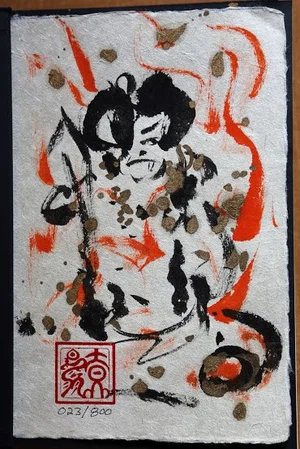
When Soke taught, he created an infinite number of works of art for students of his Hombu Dojo, with each one arising from a moment in time, much like his budo. It is important to return to these teachings and pieces of art, re-examining what has been shared with a mind open to new understanding. Many Bujinkan budoka possess such artwork; I suggest making time to share, re-examine, and challenge the current understanding of Soke’s calligraphy as experience is gained and time passes. Equally, take advantage of the work cataloged by others such as Steve Olsen in his Masaaki Hatsumi: Dojo Art books. Steve hints at these inner meanings, concepts, and historical points, drawing directly from extensive conversations with Soke and the collaborative effort that produced Soke’s art books.
As we keep training, we may find new meaning in the forms we practice. Or perhaps we will forget their meaning altogether, only to rediscover it again later in a moment of Yugen no Sekai - something profoundly mysterious!
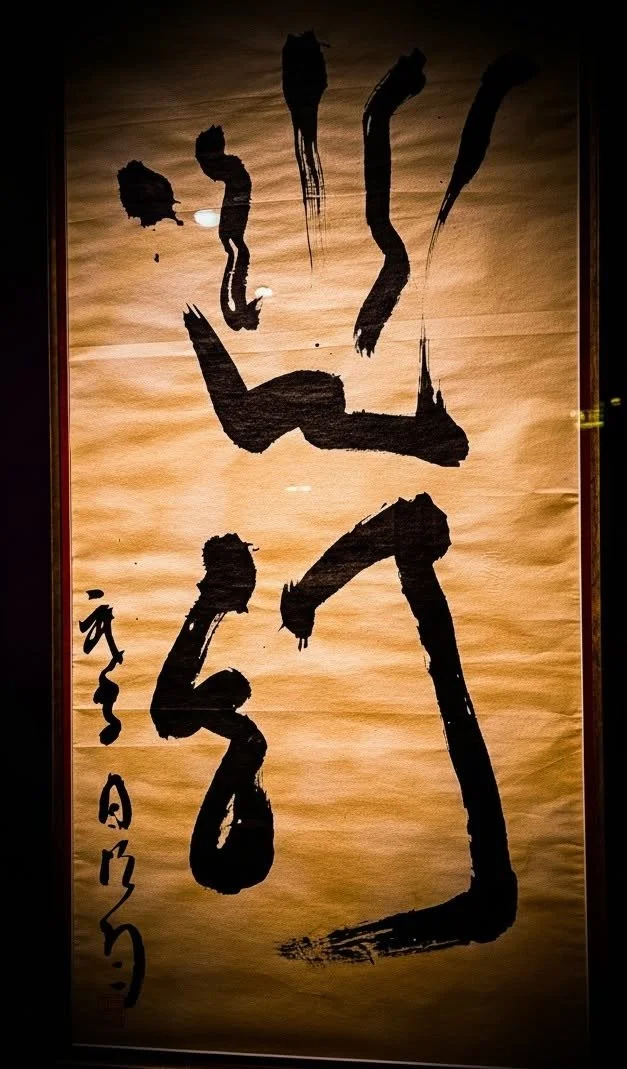
Yugen by Hatsumi Masaaki, Soke of the Bujinkan