Blog: 2013 Japan Training Trip
In September 2013, members of the Dayton Bujinkan Dojo visited Japan for training and sightseeing. More photos are available at https://www.daytonbujinkan.com/photo-gallery-i/2013-japan-trip


(The following post is a condensed version from Jeff’s full, detailed trip journal.)
From September 3-10, 2013, we visited Japan to train with Hatsumi Soke, Nagato Shihan, Noguchi Shihan and Someya Shihan. We averaged two training classes per day, and still had time for sightseeing in the cities of Asakusa and Akihabara near Tokyo.
Most training classes were small compared to previous years. Soke’s classes averaged forty students, with the Shihan classes averaging twenty students. Temperatures were hot and humid, although not as uncomfortable as year’s past. New air conditioning and extra fans installed in the Bujinkan Hombu helped to keep the dojo comfortable.
This year’s Bujinkan theme for training revolves around the Tsurugi or Ken (剣), an ancient one-handed double-edged sword being used in class to examine new ways of studying the SanShin and Kihon Happo of the Bujinkan. Many of the techniques shown with the tsurugi require using it as an extension of one’s own body.
Both Soke and Nagato Shihan spent time showing methods of training against someone cutting at the uke with the tsurugi along with sword-against-sword methods.
Soke is 82 years old this year. Soke stressed the importance of flowing from one thing to the next, and finding connections in-between movements. This was impossible to visualize most of the time, as his Taijutsu is not broken into pieces or techniques like the rest of us. It just flows.
Soke told us to connect the movements and variations (henka) as we interpret what the uke is doing. Don’t add or provide input, simply read the feeling or flow of the uke’s movement and use Taijutsu naturally.
Soke showed and explored ways of staying connected to the uke when they are taking ukemi. He explained there is no reason to disconnect from what the uke is doing, otherwise the connection and flow is lost. Let the uke take kaiten (roll), but as they come back to their feet – or attempt to – redirect their balance with light pressure to make them fall again. “Bring the floor up to them!” Soke said during one translation as the uke tried to recover from muso dori but found an osoto gake at the end of their ukemi.
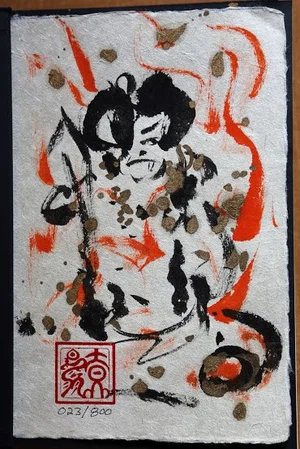
Soke created a lot of different artwork and calligraphy for students in class during tea break. In less than 20 minutes, he had produced thirty+ pieces. Many of them were quite large, taking up a good portion of the space at Hombu.
Soke created a few pieces of calligraphy for us: Tsurugi (剣, ken), jutsu (術, control via technique), and uma (馬, horse). We continue to study each one for artistic differences and interpretation.
On Sunday, September 8, 2013, Steve presented Soke with a draft of the Dojo Art book. Steve has already sold out of the first 1000 pre-ordered copies. He is currently working with his distribution chain to produce another 1000 books.
Noguchi Sensei is 68 yeara old. . Moving around from student to student, Noguchi Sensei reviewed Takagi Yoshin Ryu and Koto Ryu kata, and then explored henka of each. He stressed having the right distance to allow for the right timing to develop. More than once he corrected our angles, showing us that a poor angle was allowing for a counter-strike.
At the beginning of our first class, Noguchi Sensei asked us if we had felt the recent earthquake (地震, jishin). We said no, as we had just flown in. Laughing, he said it was a small 4.2, so nothing to worry about!
Noguchi Sensei’s hands flow and strike very quickly. From a punch he snapped on – literally – an onikudaki quicker than most of us could take ukemi. Then he laughed! When we practiced this technique, he kept repeating that the hands must flow and not be rigid in order to catch it. Stiff or “muscle-ing” the arms won’t work in the moment, and allow for your opponent to read your intention.
Noguchi Sensei started two classes instructing a student on a fan dance. The dance, which lasted about five minutes, involved a bo staff, tessen (鉄扇, fan) and specific steps coordinated to music. Duncan Stewart explained to us that the dance is based on an old folk lore of a weapon being presented to a great leader by a commoner, who then drinks with the leader and in doing so received the weapon back. Noguchi Sensei explained that he learned the dance under Mrs. Hatsumi, who was a well establish Japanese dancer.
Greg Slayton was used as uke for one of Nagato Sensei’s classes. Nagato Sensei stressed walking around the uke and keeping distance during the attack. By controlling distance, your kihon happo’s henka will determine what should naturally take place. Nagato Sensei smirked as he called this theory “Nagato’s jigsaw method”; fitting the right henka into the situation at the right time.
During my last class in Japan with Nagato Sensei, I could not place my hands in the right position to step under my uke’s arm effectively. Three times in a row, Nagato Sensei provided help to put my hands in the right position. My uke laughed, feeling my mental pain. Nonetheless, I wasn’t able to figure out the technique. Nagato Sensei told me what he was showing was a basic, but that I should keep practicing anyway.
Someya Sensei provided training on Koto Ryu Muto Dori kata. Beforehand, he spent time in class checking everyone’s sword handling and kamae. Someya Sensei corrected the class on proper cutting dynamics and footwork. Someya Sensei stressed the importance of taking notes, as notes become the student’s kihon.
During a note-taking break, Someya Sensei worked with a few students on properly unsheathing the sword (ぬく, nuku) and resheathing the sword (納刀, noto). He indicated that students who rely on guiding the sword back into the scabbard (saya) with their fingers may leave residue from battle on their blade, and possibly cut themselves in the process. Having six fingers on one hand (from splitting the thumb during nuku) was not part of the kihon!
Someya Sensei spoke about proper grip. He emphasized using all fingers firmly on the tsuka (塚, handle), and not letting your first finger point out or pinky finger drop under the pommel (頭, kashira) of the sword handle. Doing so weakens the grip, and is not proper for Bujinkan swordwork.