Blog: 2024 Duncan Stewart Seminar Retrospective
"The Great Correction"
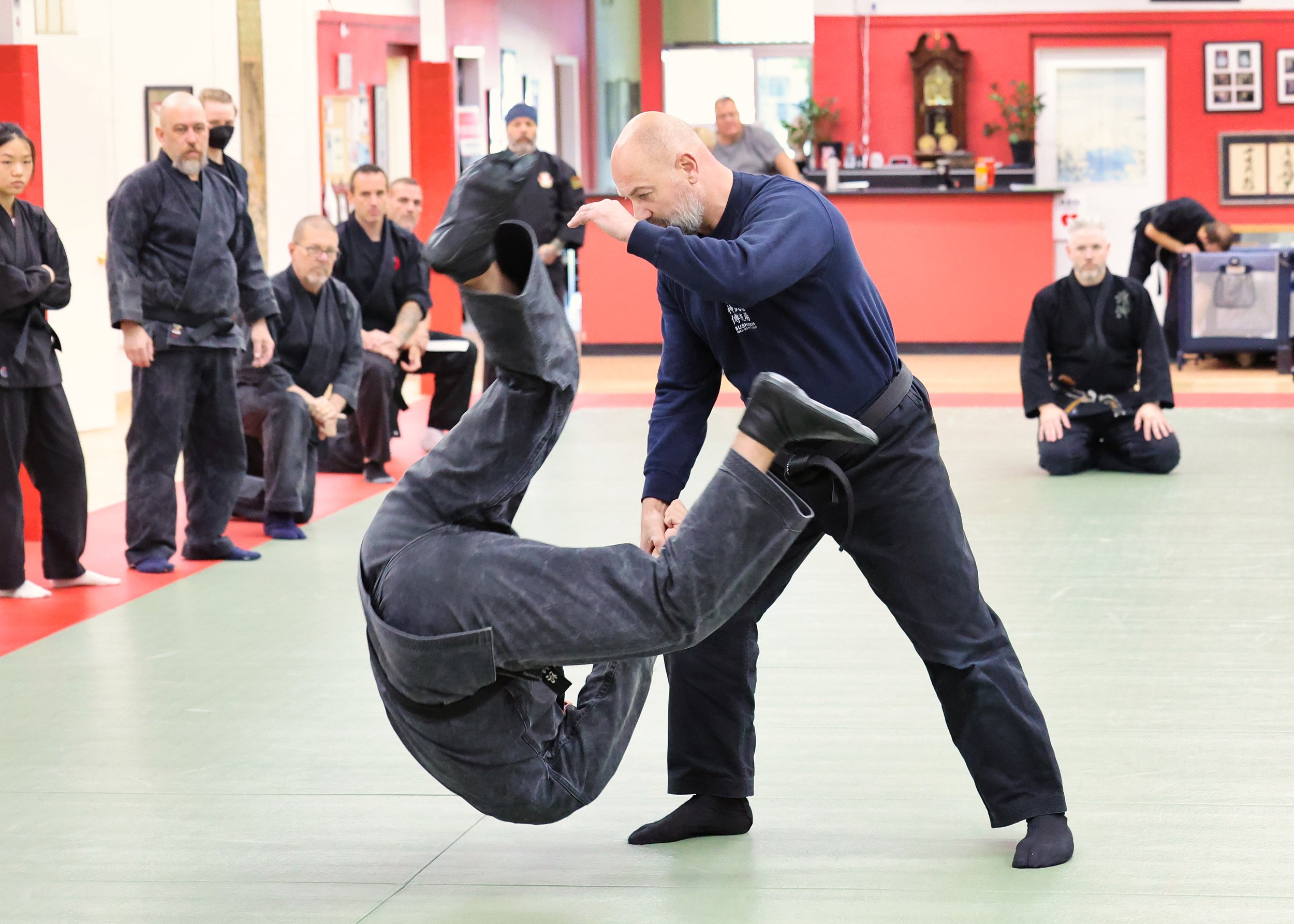
On July 19-21, 2024, Bujinkan Daishihan and Shinden Fudo Ryu Menkyo Kaiden holder Duncan Stewart from Tasmania visited the Dayton Bujinkan Dojo to teach 50+ participants in the Bujinkan arts. Students from six states and two countries attended. Those who participated in the seminar received instruction on not only how to practice correctly but why the discipline of practicing correctly is critical to discovering saino konki, or one's own capacity as a Bujinkan practitioner.
On day one, Duncan led training in the way practiced at his Japanese teacher's dojo. A student shows a random technique, and it becomes the root for improvement and variation (henka) for the class to explore. Throughout the first session, Duncan showed impeccable movement. Crisp, clean and exact. He reminded participants - perhaps warning them? - to stop fighting when training with their uke."We are studying, not fighting" was the message for the night. Duncan explained that we can't study if we are busy fighting with our uke, resisting the movement, or fighting ourselves (mentally). Don't try to win. Simply study by repeating the movement with no variation to match that which was shown. Take the ego out of the equation. Practice what was taught. Slowly. Nothing more. This first day of instruction focused on polishing the heart of our training, the Shin in Shin Gi Tai. It set the expectation for the remainder of the weekend.
As day two started, it continued to focus on training slowly while raising the bar of expectation: work toward exemplary and efficient movement. Duncan provided example after example of perfect timing, distance, and angling in all of his taijutsu, naturally finding harmony within the chaos of the uke's attack. It manifested as a dance or ballet while the uke’s demise and loss became certain. We were told to stay focused on moving slowly and copying the movement shown to perfect it. “Stop leading with your hands. Move the feet, the body, and the spine in unison.” Reminders to reduce unnecessary movement from our taijutsu was constantly emphasized, especially as we began practicing Bujinkan ryu-ha kata from the Gyokko Ryu and Shinden Fudo Ryu. Duncan stressed the need to eliminate the tendency to modify the kata or add henka when learning the form, especially before mastering it.
Throughout day two, it was important to practice what was shown and nothing more. On our own we should practice it solo, then train with a partner to harmonize the movement. Is it the same? Instruction ramped up and became stern. Duncan challenged us to be true to the form, not lazy in our practice. Move the feet, find the correct distance, then let the form develop naturally. When participants began comprehending the movement, Duncan would spontaneously show novel examples and henka, somehow with better taijutsu than his original form. He allowed us to travel with him down a path, like a bug on a horse’s tail, to see what was in the realm of possible when one commits to training efficiently and understands the kata. Instruction focused on unifying the body’s movement - the tai of taijutsu - as a core theme of day two’s training.
Day three was vicious. Like a fierce tiger, perhaps channeling the inner spirit and resolve of his teacher, Duncan seemed driven and inspired by both Bujin Moko and Fudo Myo to protect the attendees from false beliefs by cutting them down mentally when their concentration failed to reproduce the techniques properly. Feedback was aggressive and direct, as if Duncan was simultaneously guiding the student to not deviate from the correct path while concurrently protecting the ethos of the Bujinkan arts as a menkyo kaiden holder. Surely not everyone understood, and some nervously laughed at the conviction of Duncan's comments and instruction. His movement, heart, and spirit were direct and true in their purpose. He explored advanced kata of the Shinden Fudo Ryu, yet remained laser focused on the spirit and intent of the movement. When participants struggled to keep up - perhaps tired from days of training - and failed to maintain the correct distance within the kata, correction came swiftly.
Sensing the class wasn't getting the point, Duncan simplified the approach by instructing us through practical examples of proper distance using the Bujinkan's San Shin and Go Gyo no Kata but in such a visceral way as to show how the forms exude the violence of battle. Raw. Powerful. Purposeful. No mercy. Pure practicality. For those that warm up with these basic Bujinkan forms but find them having no more perceived value outside a moving meditation, Duncan showed another side of their purpose and cut down the falsehood of their implied simpleness. The secrets he shared by way of example after example of applying the Go Gyo forms against multiple opponents, with and without weapons, and at disparate distances were right in front of us the whole time. We just needed the eyes to see it. Sensing our bodies worn out from training, Duncan allowed us to rest but continued teaching our heart and mind by challenging us to strip away bad habits. He did this by challenging our ego and forcing us to think about removing distractions, unnecessary thoughts, discussions, and “chatting” in the midst of training. “Shut up and train.” Forcefully and purposefully unbalancing everyone, Duncan lectured us on practicing and training properly. For the uninitiated, this may have been their first introduction to a teaching style made of stern verbal beatdowns to drive the critical elements to heart. Like heating a blade to rid it of imperfections, Duncan's instruction and verbal acumen was aggressive at times and took some off guard, but the passion behind the lecture was from the heart to protect the art and the privilege of studying it.
The final day's session was advanced and pushed participants to question their confidence and recognize their weaknesses, reflecting on where their skills need improvement. It set the expectation that training properly and correctly is not optional but mandatory to learn the core movement and allow for the opportunity - it's not guaranteed - to deepen one's knowledge and skill. Duncan stressed that training requires us to copy the movement perfectly so that catching the feeling - kimochi de - and intent were possible. For many, although tired from two days of training, this was the aha! moment which drives change and new skill development. For others, the connection wasn't so apparent. When a participant questioned the importance of the dynamic movement observed, Duncan's response was verbally kinetic, surgical, and direct. The participant was lambasted for not paying closer attention and having the eyes to see the answer to his question from what was shown. Duncan broadened his wrath toward everyone - no one could hide from it or was immune - stressing that if we can't stay focused on copying the form as shown, with the correct distance in mind, we won't build habits to find the insights and enlightenment we are so desperately seeking from the form itself. Duncan was venomously direct in his comments, channeling his thoughts as if guided by the bujin itself for all of us to hear. Right when we thought his words were not for us or our ego's, but for someone else, he reminded us that in fact they were very much for all of us individually, and especially focused toward those who thought the comments did not apply to them. Scolded and heads down, we were reminded to use his instruction to be reborn (destroy and renew, like an uke receiving the kihon happo) and train correctly with heart and purpose. Removing our ego from the equation allows for a mental recalibration and realignment toward training properly. Duncan inspired us to challenge lackadaisical practice with purposeful training and correct intent. The training, done correctly, provides the opportunity for the enlightened mind we seek. While it may have felt uncomfortable to watch or be a part of, it was done from the heart, for had Duncan not wanted everyone to improve, he would have said nothing at all.
How should a practitioner internalize the guidance and concepts introduced by Duncan at his seminar? First and most importantly, maintain consistent practice and “keep going”. Duncan alluded to the fact that persistent training will allow you to discover and internalize proper taijutsu on your own naturally. Second, practice slowly and consistently. Take the fight out of your practice. The “fight” may be your need to win against your uke, or to chat during training, to ask questions or comment, to go fast, or to use henka when you can't perform what was shown. Instead, remove your ego's intentions and use that rediscovered time to practice slowly what is shown. When able, incorporate solo training - even if only 5 minutes a day - to perfect your form. Drill your footwork and your body movement. Visualize yourself performing the technique perfectly. Visualization helps build the mental connections needed to improve. (If it's good enough for the fighter pilot community, it's good enough for the budo community too.) It's been said by others that the dojo is a place to learn new things, whereas solo training is how you master them.
Third, use references and genuine guidebooks when available. Is the form described and available in one of Soke's books? Do you have first hand knowledge of the kata as taught by one of the Bujinkan senior Japanese instructors and menkyo kaiden holders? Perhaps you find yourself struggling to accept when a teacher says “do it this way” but your own experiences say to do it differently. Your response is a form of ukemi itself. Instead of fighting it, remove the ego and practice it as shown by that teacher in their class. Your role is to be a student. Accept this. Be in the moment. ( 一期一会 | Ichi-go Ichi-e. | "One time, one meeting".) For another perspective, consider this: when discussed with a Japanese resident about the dilemma of seeing different ways to perform the same kata or waza from different Japanese teachers, or when you are told not to practice it a certain way even when you are confident that is how it’s practiced, the guidance remains the same. Practice it as shown in the class you are attending. Absorb the corrections in your movement without ego - this will lead to new understanding. Done properly, you now have the benefit of seeing more than one way to practice the kata or waza when you thought it already known. You'll gain insight - good and bad - and learn ‘how to learn’. It's okay to be wrong; yesterday's right may be today's wrong because of new information. Tactics and lessons learned change the way things are practiced. The Bayesian Principle can guide us here. If you are struggling with this, take credence from others who have traveled the same path.
This also begs the question, are you too rigid mentally to allow for such discovery? Isn't that why we train, to discover new ways of efficient movement, both mentally and physically? Remember, it's a journey, not a race to win. Give yourself the mental flexibility and freedom to ‘enjoy the view’ and experience the uniqueness of studying the Bujinkan’s kobudo movement. Recognize that the kata and waza are the framework to mastering the feeling, flow, and forms. They provide the direction, the north star, the azimuth to self discovery.
Many have had the pleasure of knowing Duncan for twenty+ years, meeting him back when he lived in Japan, or when he visited the US (pre-COVID) to teach seminars. Each time his budo inspires. This time though, not only did he push us to study diligently and with unwavering focus, but also showed us how to protect the privilege of training in the Bujinkan arts by holding ourselves accountable to that responsibility while being true to the core of Bujinkan Budo Taijutsu movement. Let your passion for budo training lead to discipline in your approach. Even if you were unable to attend the seminar, let these lessons guide your focus and inspire your training.
Thank you Duncan for sharing your budo, and perhaps its ishin denshin (divine transmission), so that we may improve. Bufu Ikkan! - Jeff O.
(More photos from the event are available at https://www.daytonbujinkan.com/photo-gallery-ii/2024-duncan-stewart)