Blog: 2012 Japan Training Trip
From June 22-30, 2012, Dayton Bujinkan Dojo members and friends met in Japan for training. More photos from the trip are available at https://www.daytonbujinkan.com/photo-gallery-i/2012-japan-trip
(The following post is a condensed version from Jeff’s full, detailed trip journal.)
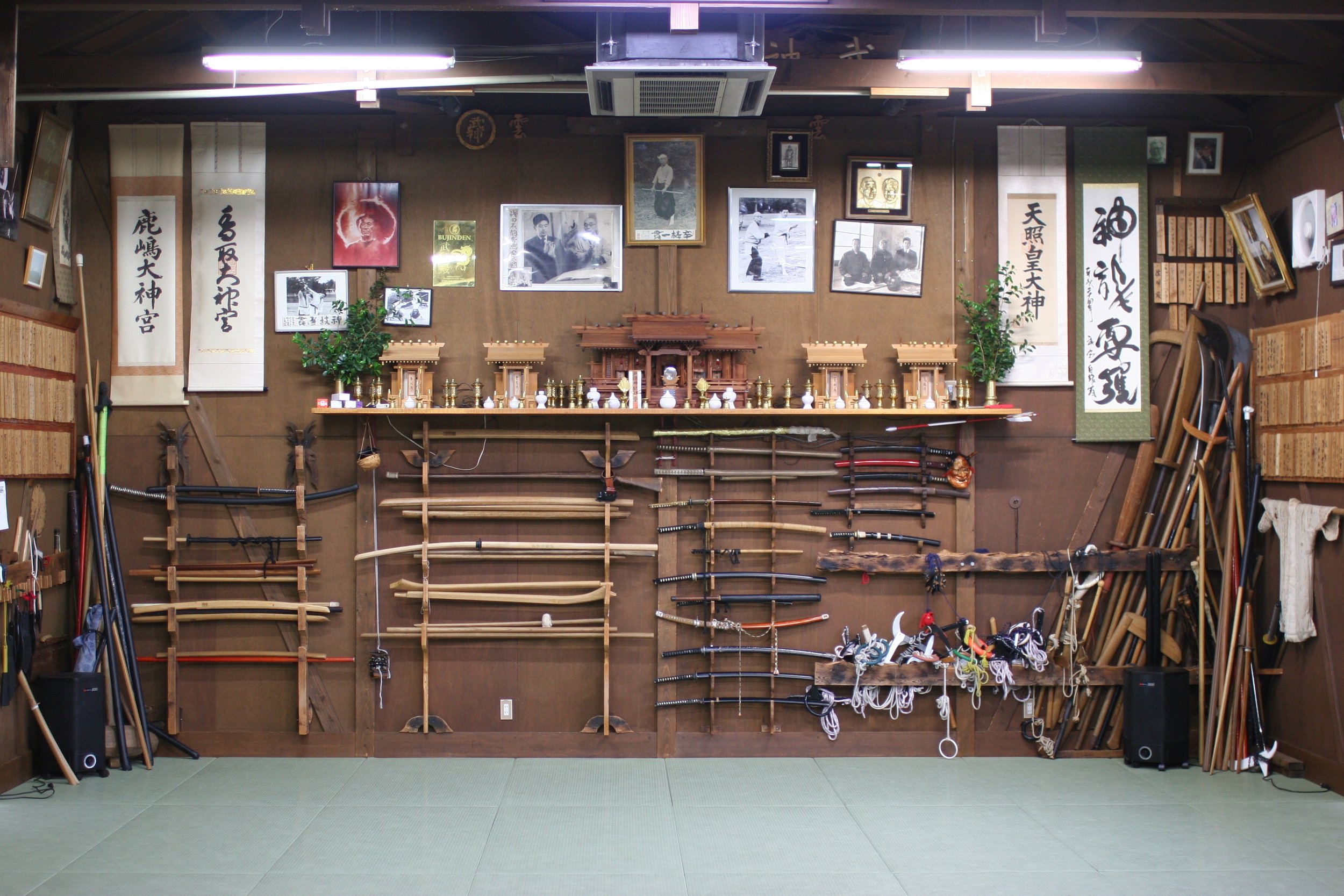
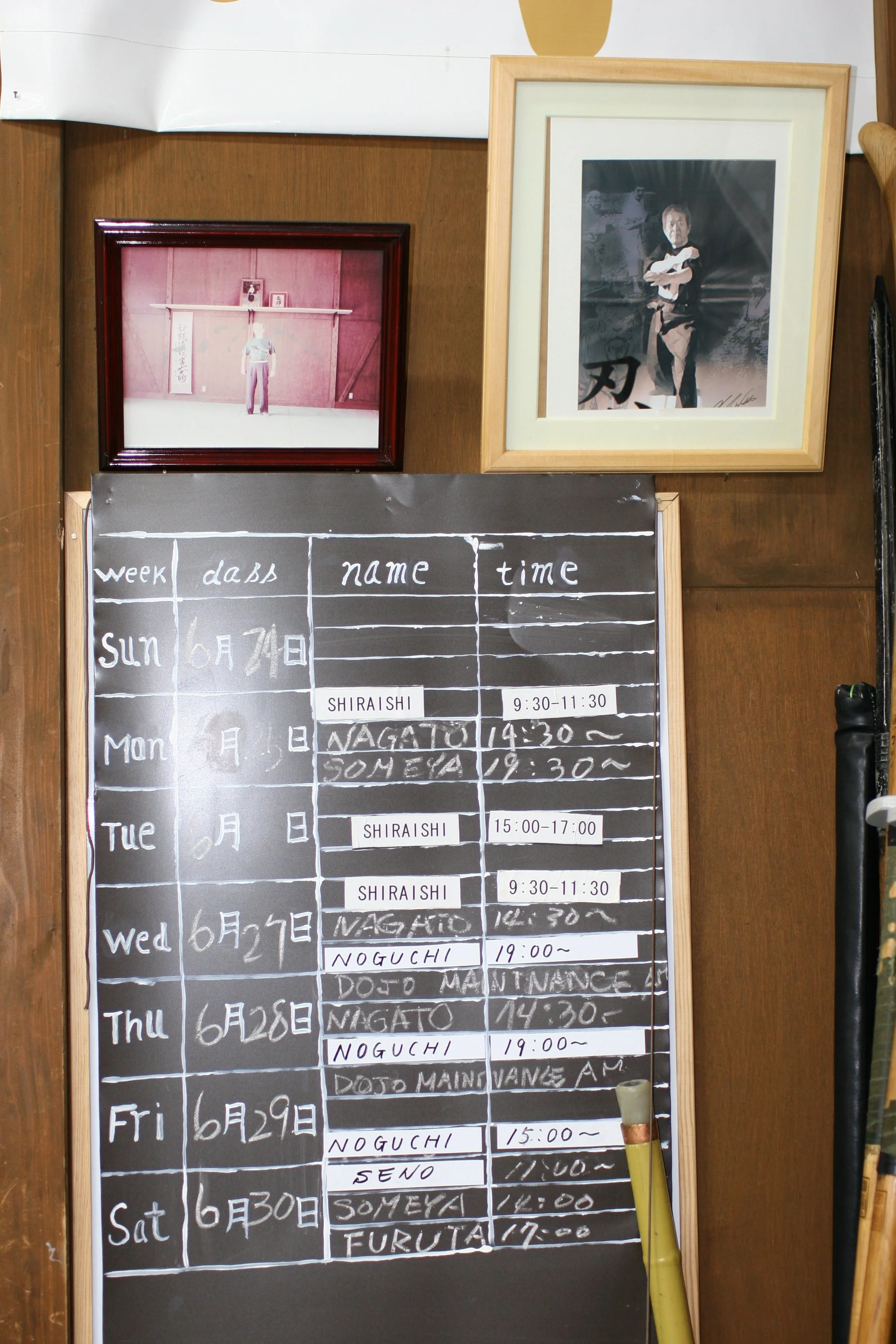
We trained with Hatsumi Soke, Nagato Shihan, Noguchi Shihan, and Someya Shihan. The class sizes were between ten and fifty students, with Soke's classes being the largest. There were a number of other students from around the world visiting, including Argentina, Spain, Canada, US, Italy, Sweden, and Germany. As Soke has said in the past, the Bujinkan is a bit like the United Nations.
Soke spoke about vital points and fighting with no feeling (or hiding your intent), while the Shihan focused on maintaining the right feeling or spirit during a technique.
Soke's training primarily focused on the concept of kaname (要 or かなめ), or 'pivot point' in taijutsu. One example of kaname given during training was to think of applying omote gyaku to control the uke; done correctly it controls at an anatomical pivot point. Using a different example, a Japanese-style hand fan (uchiwa or ogi) has a kaname at the area where all the fan blades come to a single point on the handle.
Soke explained that kaname is part of the movement, and naturally leads toward additional Budo Taijutsu concepts such as juppo sessho (all directions/options), gokui (secrets) and ku (void).
On a number of occasions Soke spoke about developing the right timing in our movement and naturally switching from one technique to the next without giving anything back to the uke. Being able to “pivot” from one point to the next (kaname) at the right time was constantly stressed.
Soke spoke about pain as an instrument of time – changing the flow of things when necessary through pain or mental pressure was just as much a part of kaname as a physical technique.
Soke applied pain to his uke constantly – attacking the bones in the hands, the face and arms while the uke tried to escape or recover from his techniques. He told us Takamatsu Sensei (高松 寿嗣, 1889-1972, his late teacher) taught in the same way, applying various pressures and pain to influence movement, and now Soke was simply passing it on to the next generation, as that is the way it is done. “This is the process” Soke said. He told us his teacher (Takamatsu Sensei) could plow his fingers through coffee tables and wallboard quite easily. On at least one occasion Soke applied a technique with the the feeling of creating pain to make the uke react, but actually never applied the pain. Soke said this an aspect of mind control.
For many years Soke has spoke about having the right “feeling” - the kimochi de – when doing a technique. However, he warned us that feelings (intent) can be understood by the opponent who may read your movement and use it against you. Soke stressed having no feeling at all; if we input our own spirit or emotion into a technique, the opponent may interpret it and defeat our actions.
During one technique in class, Soke entangled the uke with his bo staff, then threw the uke across the room. As the uke rolled away, Soke tossed the tip of the bo at him, smacking his face as he rolled. This shocked the uke, who hadn’t expected to be injured during the escape. Soke spent the next few minutes speaking at length about not taking ukemi; ukemi must be hidden. If the tori knows you are able to roll away, then they will use that against you as a way to hurt you while you attempt to take ukemi.
Soke further explained that this is why he teaches with no feeling, and stressed “henka within henka” (variations within variations) without feeling so that nothing is tangible to the uke.
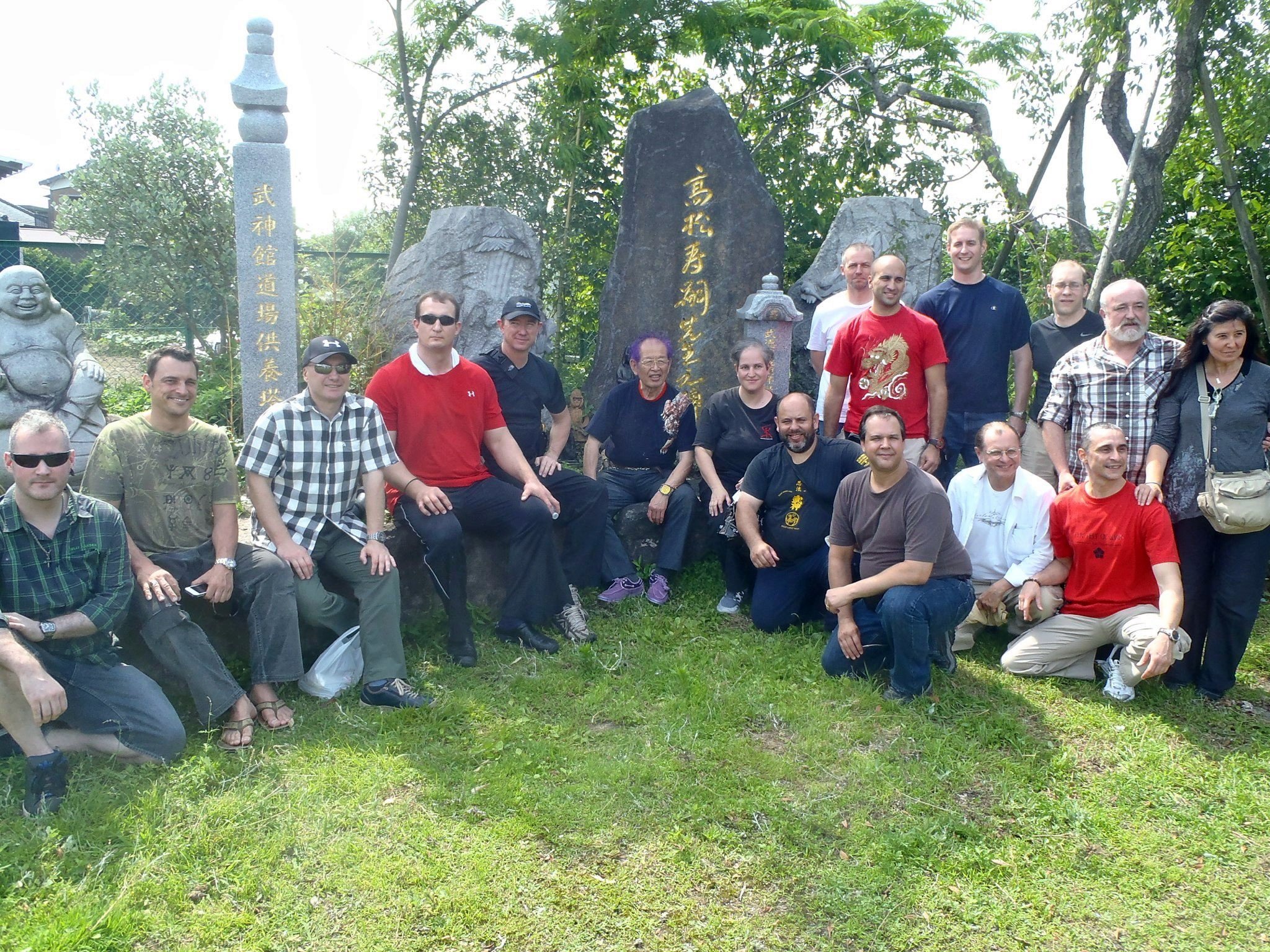
Soke invited us to his country home to visit the Takamatsu Sensei Memorial and eat lunch with him. The memorial is dedicated to Soke’s late teacher. During a short lunch break, Soke explained that he eventually wants a Bujinkan shrine built,and to have a section for past Bujinkan Shihan who have died. In one hundred years from now, he wants people to know who was part of his Bujinkan.
Nagato Sensei’s classes averaged 10-20 students. He warned us to not think of what he was showing as having the freedom to do any henka we wanted. The feeling had to be right. At one point during class, he told all of us that we were practicing too much of the physical side of the technique demonstrated. What he was showing was the feeling and spirit of the technique, which was similar to studying a graduate level course. He then went on to say we were all “maybe kinder-garden level” because we could not “catch” his feeling. Nagato Sensei is very good at keeping us in the right mind set.
Nagato Sensei stressed honpa - half way - when doing a technique. He did not want us to focus solely on the physical side of a technique, giving it 100% of our energy. Instead he wanted us to focus on an equal part of the physical side and “feeling” side of a technique. “Fifty-fifty” he said. Too much focus on just the physical side is easy for an opponent to read.
Nagato Sensei had us practice Harai Goshi Nage, Koshi Nage, and Seoi Nage multiple times during class in Asaka Dai. He explained the difference between sweeping the hip, performing a hip throw, and throwing over the back.
Nagato Sensei spent a lot of time talking about senior ranks. In the Bujinkan, the most senior rank is 15th Dan, but in reality, there is no 15th Dan, only 10th Dan. The 10th Dan has five levels in it (Chi Sui Ka Fu Ku), but it is easier to say 15th Dan. The 15th Dan rank represents the practice seen in traditional Japanese culture from the warring states period (Sengoku Jidai, 戦国時代, 1467-1603). During that time, when a boy turned 15 he was allowed to carry a real sword (instead of a wooden one) and go into battle. It didn’t mean the boy was a warrior yet, just that he had the capacity to become one from that point on. The 15th Dan rank in the Bujinkan is no different.
Nagato Sensei talked about giving the godan test. He said the test is for the 15th Dans and 5th Dans alike. If the 15th Dan fails to give the test correctly, the student being tested will fail. Nagato Sensei explained that when Soke took the test under Takamatsu Sensei, it was with a real sword, and only once.
Nagato Sensei finished his tea break saying not all deshi (students) will be good at the Bujinkan (martial arts). “That is ok. Soke only needs a few, or maybe one.”
Someya Sensei focused on Kukishinden Biken Waza. My ribs were quite sore from many repetitions of do kiri body cuts during the bokken training.
Someya Sensei provided a lesson on sword etiquette. He spent time explaining the omote and ura sides of a sword, the different methods of wearing and handling a sword, and how to pass a sword to someone properly.
Noguchi Sensei turned 71 this year. This year we observed Noguchi Sensei give a Godan test in his class. The previous day, a student had taken the test in Soke’s class but failed. However, Soke and Noguchi Sensei spoke and it was decided the tester - a foreign 15th Dan practitioner - giving the test was quite bad at it. His energy, form and cut were not in sync. Because it was the student’s last day in Japan, Soke allowed Noguchi Sensei to give the test again at the end of Noguchi Sensei’s class. As expected, the student passed without a problem. .
Noguchi Sensei reviewed “Shihodori” techniques, four basic locks of an uke on the ground. Locking us each on the ground with an arm bar, the pain was high enough that we did not want to fight back.
“Bujinkan housekeeping” was brought up in discussions. Specifically, the subject of oversees practitioners bragging about their time training in Japan when they had in reality not trained in Japan for a long time. Things written on the internet make it back to Japan in one form or another. One Shihan reminded us that it was important to be honest in our training, and not to capitalize on martial arts in a negative way. Also, it is rude to show up for class late. In one specific class, twelve foreign students showed up late to a Shihan’s class after it had been cancelled. The Shihan had already waited 20 minutes but only two people attended. After the Shihan left, the twelve students arrived, and were upset that class had been cancelled. It was stressed to us that we are responsible for our own training, and being on time is part of training. Especially in Japan, being late is a cultural slap in the face. Unless arrangements have been made ahead of time, don’t be late.
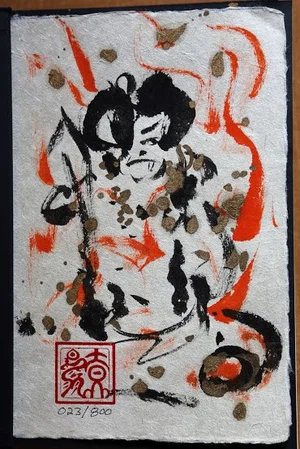
Soke created calligraphy that read Shiho Happo (四方八方).