Blog: 2011 Japan Training Trip
A few members visited Japan for training from August 25 to September 2, 2011. This was the first trip after the major earthquake and fukushima nuclear plant accident. Mark Gregory passed his godan test! Notes from the trip are below. More photos from the trip are available at https://www.daytonbujinkan.com/photo-gallery-i/2011-japan-trip

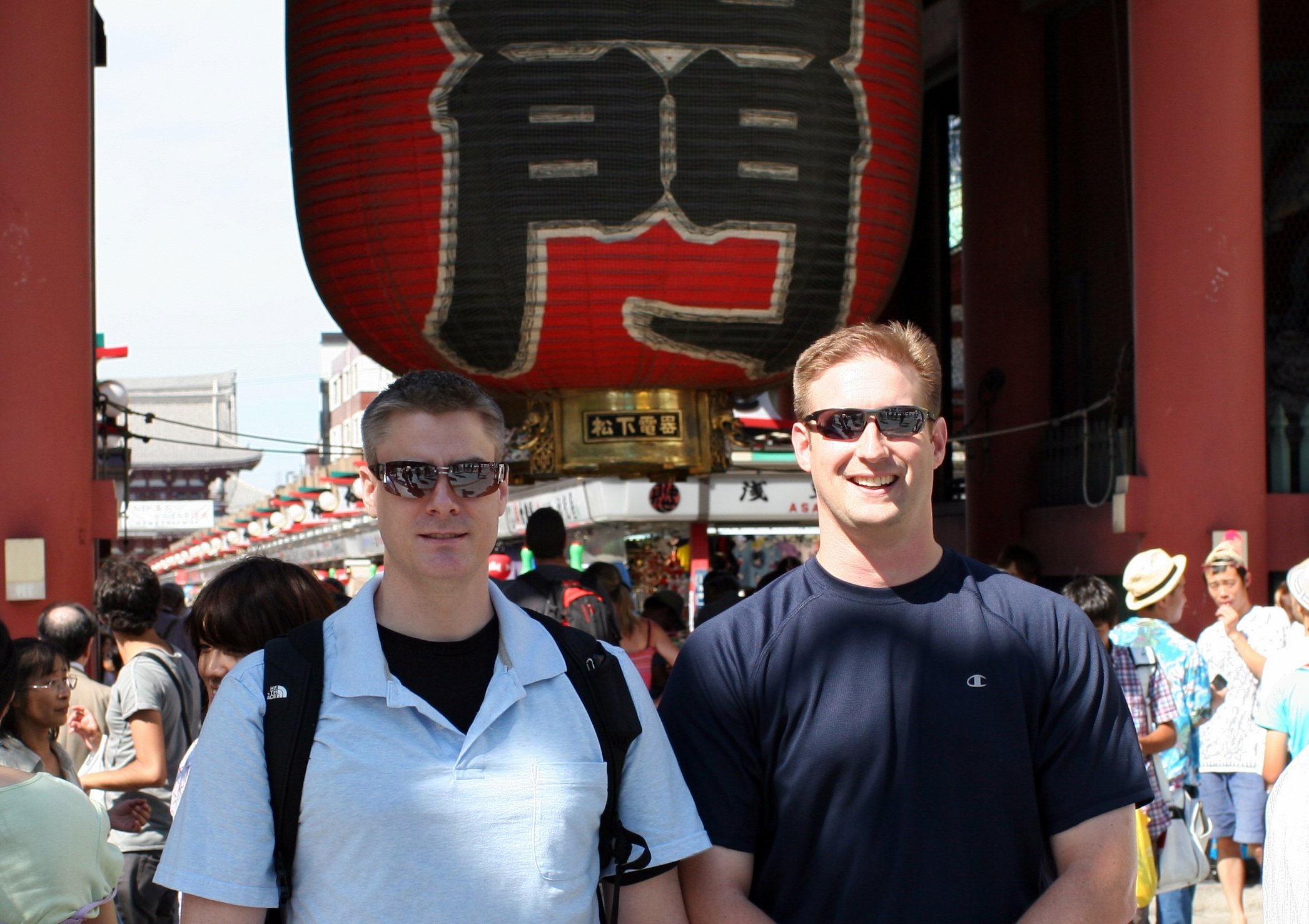
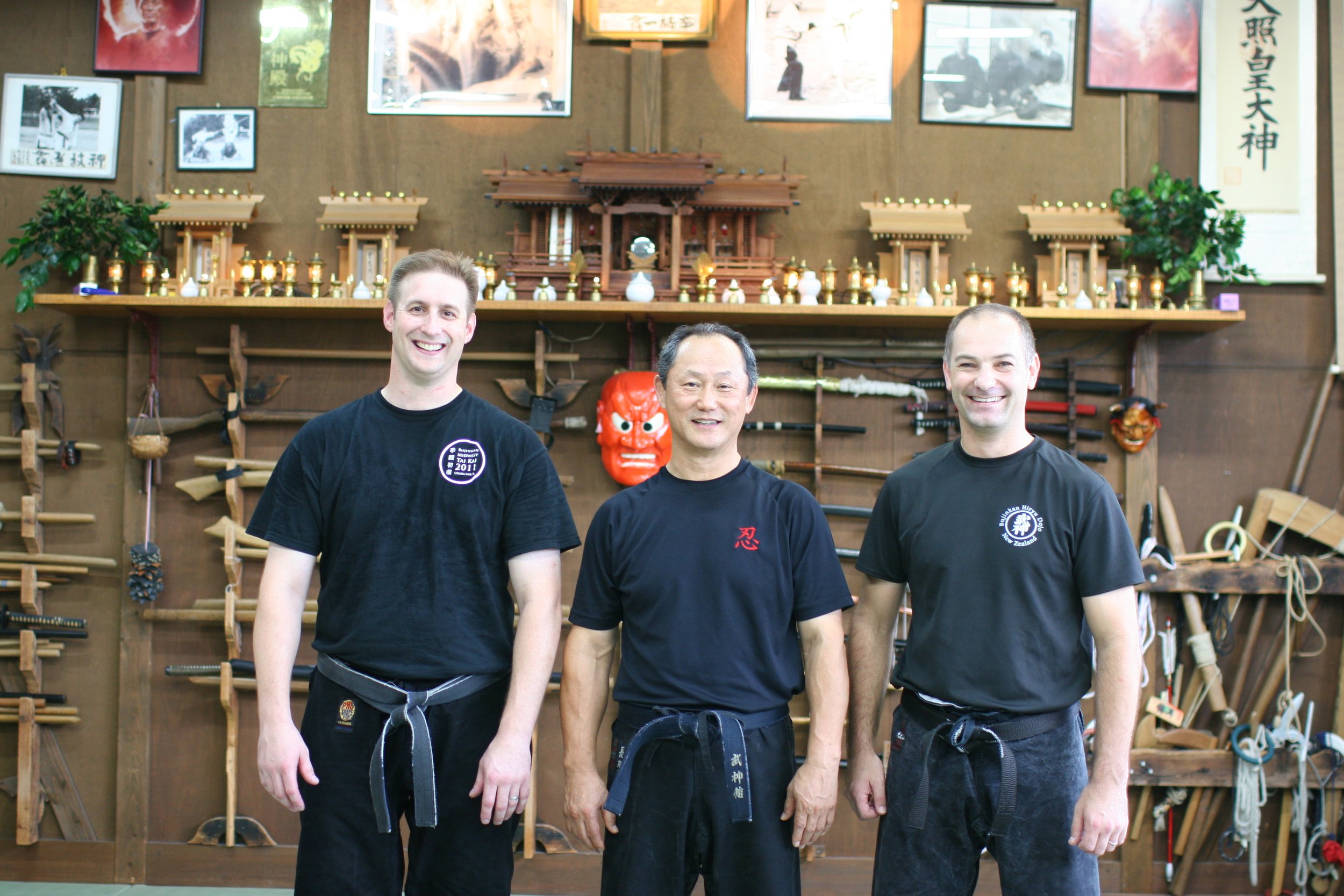
(The following post is a condensed version from Jeff’s full, detailed trip journal.)
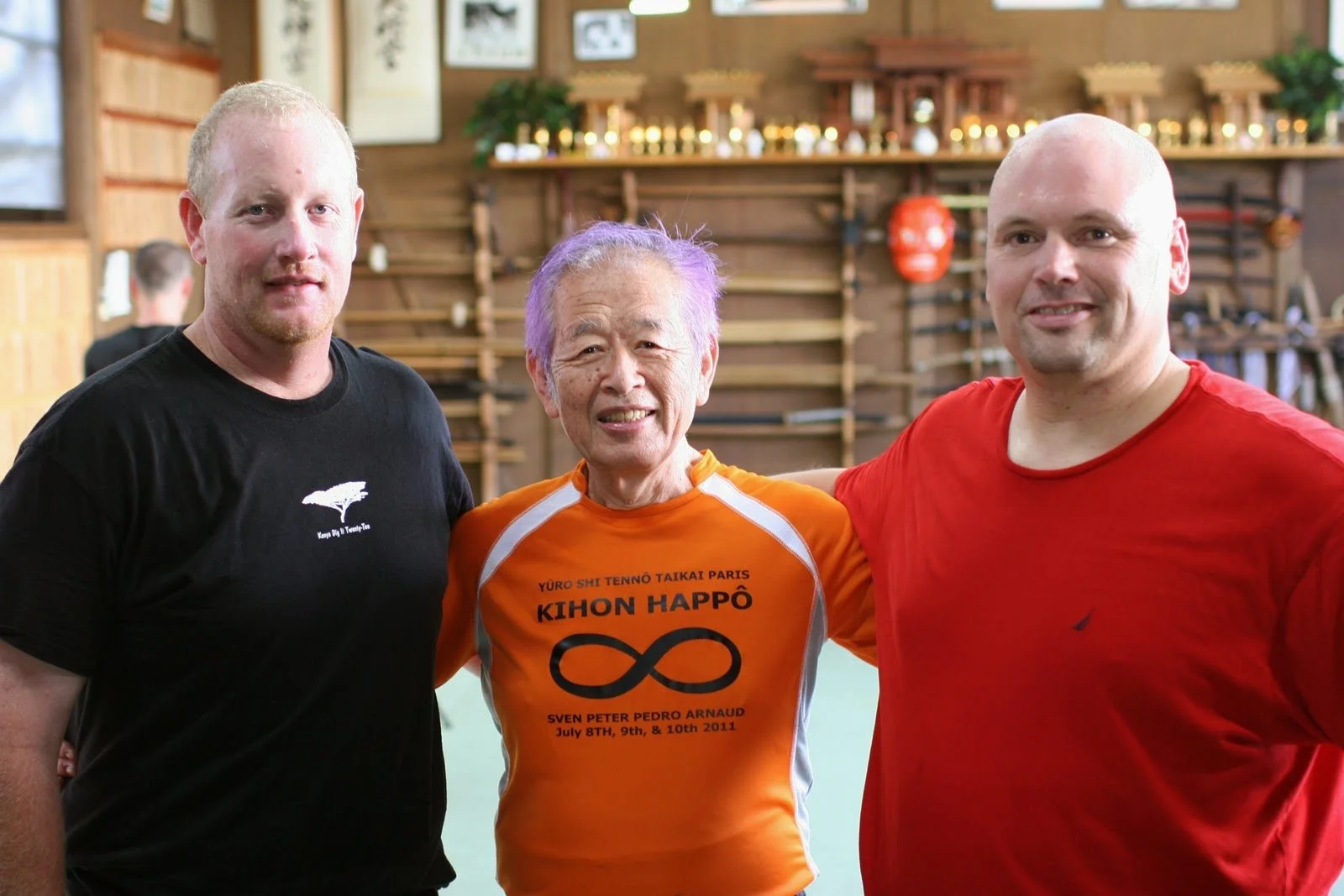
From August 25 through September 2, a few dojo members along with friends from Jackson Tennessee Bujinkan Dojo attended twelve classes with Hatsumi Soke, Noguchi Shihan and Nagato Shihan at their respective dojo in Japan. We also attended an exhibit called Kukai's World (Kukai, 空海, founder of the Shingon-sect Esoteric Buddhism) at the National Museum in Ueno, Japan. The exhibit brought together Kukai's rare artwork, scrolls and influential sculptures from across Japan.
Class sizes were small. Our first class with Hatsumi Soke Friday night had 26 people in it. Normally there would have been 80-120 students in class. During the first third of a Noguchi Shihan class, there were two of us in class. Great way to learn Gyokko Ryu kata. Even at Ayase, class never reached much past forty students.
Because of the smaller classes, there was a bit more “hands on” training. Soke would come around and make pointers to groups of students training, correcting their movement, and commenting on the feeling (kimochi de) of the techniques. Nagato Shihan spent time correcting everyone's movement as well.
Soke is in his 80th year. After nearly 53 years of studying his teacher's martial arts (Takamatsu Toshitsugu, 高松 寿嗣 1889-1972), you don't see a martial motion when he teaches. It's just movement.
Soke stuck the end of a bo staff underneath the eye of his opponent and trapped him on the ground. As his opponent tried to escape, he spun the bo over and smacked him on the head. He explained the importance of using the opponent’s energy (resistance) against them. It was important to take the ukemi from the uke. “There isn't an escape, is there.”
Soke spent a lot of time showing examples of the relationship between the eyes, fingers, and heart/spirit. He explained that these three things are connected. Controlling the fingers of his opponent caused pain, which closed the eyes. This in turn took the will (or heart) out of his opponent's fight. Other times, his fingers were used to control the eyes of his opponent. Soke explained each finger should be sensitive enough to interpret direction, control, and resistance in order to adapt to what the opponent is doing.
When Soke applied his fingers to an opponent's face or neck, they commonly withered to the ground in pain, at which point Soke would laugh and hold them in place. He went around class during one training session and applied his finger techniques on nearly everyone. The pressure of his fingers on different points of the face was much stronger than any of us imagined. He is not using his nails, rather the bones of his fingers with his body weight behind each one. There was no method of escape without ripping your face or injuring yourself when he applied this.
While his opponent squirmed on the floor, Soke would say “Don't give them anything. They'll defeat themselves, won't they?” This was commonly interpreted as don't give the opponent anything that they can take. Instead, let their attempts to escape defeat themselves.
During another training session, Soke showed how to use the fingers with the body to strike the opponent's midsection. “Use it with the body” Soke said. When I tried to strike my partner with my fingers during practice, Soke came over and told me that I had to use my body behind the strike, showing it to me while I shadowed his movement. He then repeatedly went around and showed others how to use the strike with the body, not just using arm muscle.
Soke used a shikomi-zue chigiriki hanbo or bo staff (仕込み杖 契木, commonly shown as a hidden weapon within a staff or cain) with a hidden corded hook on it. He wrapped his uke up with it without touching the cord that connected the hidden weapon to the staff. Soke stressed this type of movement through walking, not placing or stringing the cord with the hands. Reaching and grabbing would cause the opponent to interpret what was taking place. Soke told us “Move with the legs. Small steps, not one big step.”
During one session of sword work, Soke ended class with a point about training with real weapons . He said if you practice with a sword you should at some point practice with a real sword. The principles are the same but there are differences in how a real sword is handled (verses a practice sword or bokken). To be a proper budoka, you have to handle the real thing at some point. This extended to other disciplines as well (firearms training, swimming, etc.).
During class at Ayase Budokan, Soke had all of us sit in fudoza no kamae and bring our forward leg to our chest with our arms to stretch. Noguchi Shihan was sitting next to me as I attempted to do what Soke showed.
Noguchi Shihan commented that flexibility was not enough, you have to know how to use the legs properly to kick as skilled as Soke.
Soke stressed the use of a piston kick like a kakushi keri (hidden kick) to the sai (inner thigh). Soke then struck his opponent during an attack and said, “I am hitting the sai here. If I did it with more force the uke wouldn't get up.”
During the Friday training session, Soke practiced moving in a way to let the opponent think he had made contact with his strike. This was very difficult for us to understand and practice. Soke told us that illusion (錯覚, sakkaku) can be used to control space. Soke spent a lot of time talking about controlling the space (kukan) with the illusion of being there for the strike.
Soke mentioned that the feeling (kimochi de) and confidence (jishin) are the most important things. “Gain confidence in what you are doing, Be confident that it will work. Have the right feeling.” Soke also played with the double entendre of the word jishin, which can also mean earthquake.
This trip was our first back to Japan after the earthquake and tidal wave in March (2011) that Japan experienced. The nuclear accident in Fukushima is still on everyone's mind. Many of Soke's classes were quite small because students are not traveling to Japan at this time.
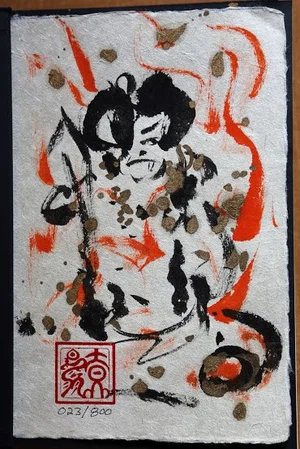
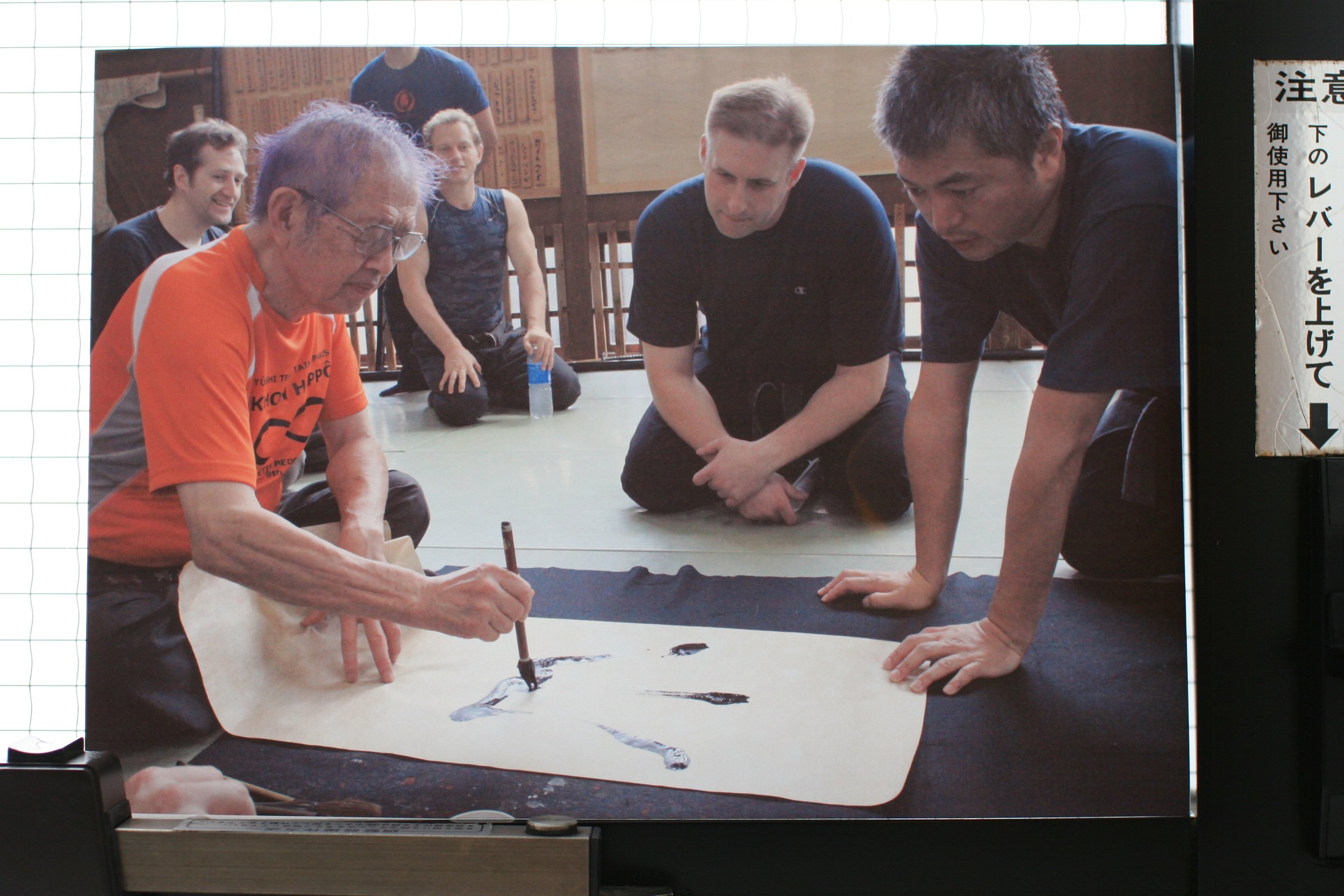
Soke spent a solid thirty minutes each class at Hombu creating artwork and enjoying a tea break. He created calligraphy that says Kihon Happo, Muto Dori, and Yuugen for our dojo. His comments on Kihon Happo were interesting, as he spoke about “destroying and creating” rather infinite basics. The calligraphy Yuugen (meaning subtle awe or profoundly mysterious) was difficult to understand. Normally yuugen (as part of yuugen no sekai) is written 幽玄. Soke wrote it with a relationship to what he was teaching in class (striking with the fingers).
I had a chance to train with Duncan Stewart, one of Nagato Shihan's students, during a few classes. Training with Duncan in a Nagato Shihan class is like taking an open-book test and failing miserably.
Nagato Shihan talked about Shu Ha Ri (守破離, - protect, break, leave) in the context of a process to train. He elaborated on how to practice a technique. Shu is learning the technique. Ha can be seen as being able to do the technique applicably. Ri is being able to do the technique from anything.
A concept explained by Nagato Shihan was the tactic of letting the opponent loose on their own so that you don't have to win. Said another way, if you try to win, the opponent can take that from you, and they will win. Instead, give nothing to the opponent, so there is nothing to win. With nothing to win, they lose by default. You don't win either, as it was never about winning or losing. Nagato Shihan told us to be disciplined and have the concentration (集中する, shuchu) and fortitude to study these points.
Nagato Shihan didn't like the way we were punching during one class. He had the entire class line up and practice punching, similar to San Shin, into the hara (belly) of our partners. He told us to watch our alignment and use the body. “It is not a muscle strike. It is a body strike to knock them back”. This style of punching extends to the fudoken, urashuto, ishitanken, etc. “Practice 1000 times. To master it, practice 10,000 times.” Nagato Shihan corrected us constantly during this exercise: “Don't slide the rear foot past being inline with the body during the punch. Some people are sliding their rear foot backward behind their body. This is not correct. Bujinkan punching is inline.”
Noguchi Shihan classes focused on the Gyokko Ryu, Koto Ryu, Kukishinden Ryu (bojutsu), and Shinden Fudo Ryu.
Noguchi Shihan focused on controlling the space around the opponent. While the opponent attacks, there are openings around their attack than can be manipulated via the right timing, distance, or flow. Letting the opponent's punch glide by and manipulate the area underneath the punch.
During one of Soke's classes, Noguchi Shihan came around to different groups and showed kicking techniques. Being able to heel hook, swing kick, stomp kick, toe kick, and hidden kick in any direction was stressed. With one of us punching at Noguchi Shihan he showed us how the movement was the same whether performing the kata with a kick or with a shuto. The feeling was the same.
Noguchi Shihan reviewed many of the bojutsu kamae when we practiced Kukishinden Ryu Rokushakubojutsu (bo staff). Details about properly holding the staff in Seigan, Gedan, Tenchi, Ichimonji, and Ihen no kamae were stressed.
Many of Noguchi Shihan's hanbo waza were based on acting like an old man with a cain, then explosively attacking the opponent. He would maintain distance and use the length of the hanbo to strike at the opponent's hip, face, knee, neck, and thighs.
Mark Gregory passed his godan test under Noguchi Shihan on the first try at Ayase Budokan.
Soke mentioned there are now enough good senior practitioners so that perhaps the Bujinkan isn't really needed anymore. The translator verified with Soke that he translated what Soke said and that it was correct. (There was no mistranslation.) Thinking about this, the Bujinkan, an association created by Soke as the vessel, or proxy, to teach his martial arts from, may no longer be important in the future if good practitioners exist now. If you “keep going” and stay true to the feeling and spirit of Soke's martial art, then perhaps that is all that is needed.