Blog: 2008 Japan Training Trip II
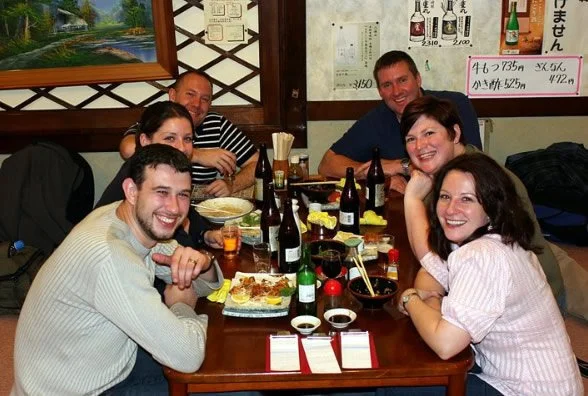
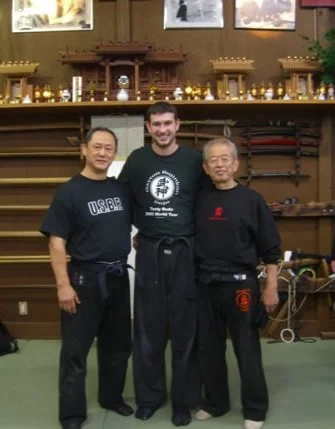
During the second week of November 2008, a group of Dayton Bujinkan Dojo students and friends were in Japan to train with Hatsumi Soke and the Bujinkan Shihan. Below are photos and notes from the trip.
(The following post is a condensed version of Jeff’s full, detailed trip journal.)
The group trained primarily with Hatsumi Soke, Noguchi Sensei & Nagato Sensei. Most of Soke’s classes had 80-100+ students attend, with fewer students in the Shihan classes. Hatsumi Soke looked great at 77 years old.
Greg & Alan both took and passed their Godan (5th Degree black belt) tests.
We presented Soke with a signed photograph of all the students (120+) who attended the Midwest Bujinkan Tai Kai event in August 2008 at the Dayton Bujinkan Dojo. Soke seemed pleased to view it, and stressed that good people with good hearts should work together for such an event.
Hatsumi Soke’s classes revolved around the Togakure Ryu & controlling space. This year’s theme is based partially on understanding the spatial relationship within the area that separates you and your opponent - the omote of the kukan. Soke briefly mentioned that next year’s theme may involve the inner, or ura side, of the kukan. In class, Soke explained that he is working within the ku (space or void), and not really creating anything when dealing with his opponent. The kukan (space) is like air; it is everywhere and ends in peaceful state (from a turbulent state). Soke also commented that budo was for sustaining peace, not war.
During one class, Soke placed a sword in his obi and moved through a movement with an opponent. He did not actively draw or use the sword, but it found its way into the waza naturally from his movement. Soke explained that this type of taijutsu was very difficult for an opponent to understand or counter.
At the end of Soke’s last class, he told everyone that the phrase Chi haya furu kami no oshie wa tokoshi ni tadashiki kokoro mi wo mamuroran will be said at the beginning of every class.
Noguchi Sensei’s classes were focused on the basics, or kihon, working through different sections of the Ten Chi Jin Ryaku no Maki. He started one class showing the proper way to roll, leap, drop, and angle in the Bujinkan method. At one point while the class was practicing ukemi, he implied that we were all doing too much Judo ukemi. Bujinkan ukemi focuses on the elbows and knees, which keeps your hands available.
Nagato Sensei told us that the idea of “no surprises” is an important concept to grasp. We shouldn’t be bothered/surprised by attacks that we didn’t see coming; we should instead react naturally to them. “Keep going and adapt. To survive is all that is important.” This is one idea of Banpen Fugyo – 10000 changes, no surprises.
Nagato Sensei is 62 years old this year.
While having difficulty copying a technique in class, Nagato Sensei commented that it was important to try, but really we should try and succeed (don’t lose focus on the goal). Little by little, we will get better.
We have a responsibility to know the basics in the Bujinkan, which means we have to practice the kihon with the right intent. The san shin no kata, kihon happo, and basics are crucial to understand if we ever want to reach the stage that Hatsumi Soke & the Japanese Shihan have reached.